
Running a Sex Offender Check in Burnet County
The Texas Department of Public Safety manages the statewide registry under Code of Criminal Procedure Chapter 62. Begin there for Burnet County addresses and names. Search by county or a local city such as Marble Falls, Burnet, or Granite Shoals, then open the full profile and verify the identity carefully.
Local police register people who live inside municipalities. The Burnet County Sheriff serves as the registration authority for county residents outside a municipality. Local authorities verify information, maintain their registration records, provide required school notice, and transmit updates to DPS. The statewide page is the primary public display; no separate county registry database was documented.
Searching the Texas Public Sex Offender Registry
The official Texas Public Sex Offender Registry supports several ways to find Burnet County profiles. Spelling, move timing, reporting, nonpublic juvenile orders, and an out-of-state duty can affect results, so absence from one query does not prove absence from every jurisdiction.
- Open the DPS registry and review its conditions of use.
- Choose a name, address/location, institution of higher education, or map search. Select Burnet County when using the county filter.
- Review the result list and compare name, aliases, photograph, age, and physical description instead of relying on a name alone.
- Open the profile and read the current registration authority, address or location, status, offense, risk level, and other public fields.
| Search control | Type | Required | Use |
|---|---|---|---|
| Last name | Text | Mode-dependent | Primary name field; spelling matters |
| First name | Text | No | Narrows name results |
| Street address | Text | Mode-dependent | Searches a Texas location |
| City or ZIP | Text/selection | No | Localizes the location search |
| County | Selection | No | Select Burnet County |
| Institution or map | Mode | No | Campus-related or geographic browsing |
Burnet Searches Across State Lines
The U.S. Department of Justice NSOPW search is useful when a safety check crosses Texas borders. It federates participating jurisdiction registries rather than replacing the current DPS profile for a Burnet County address.
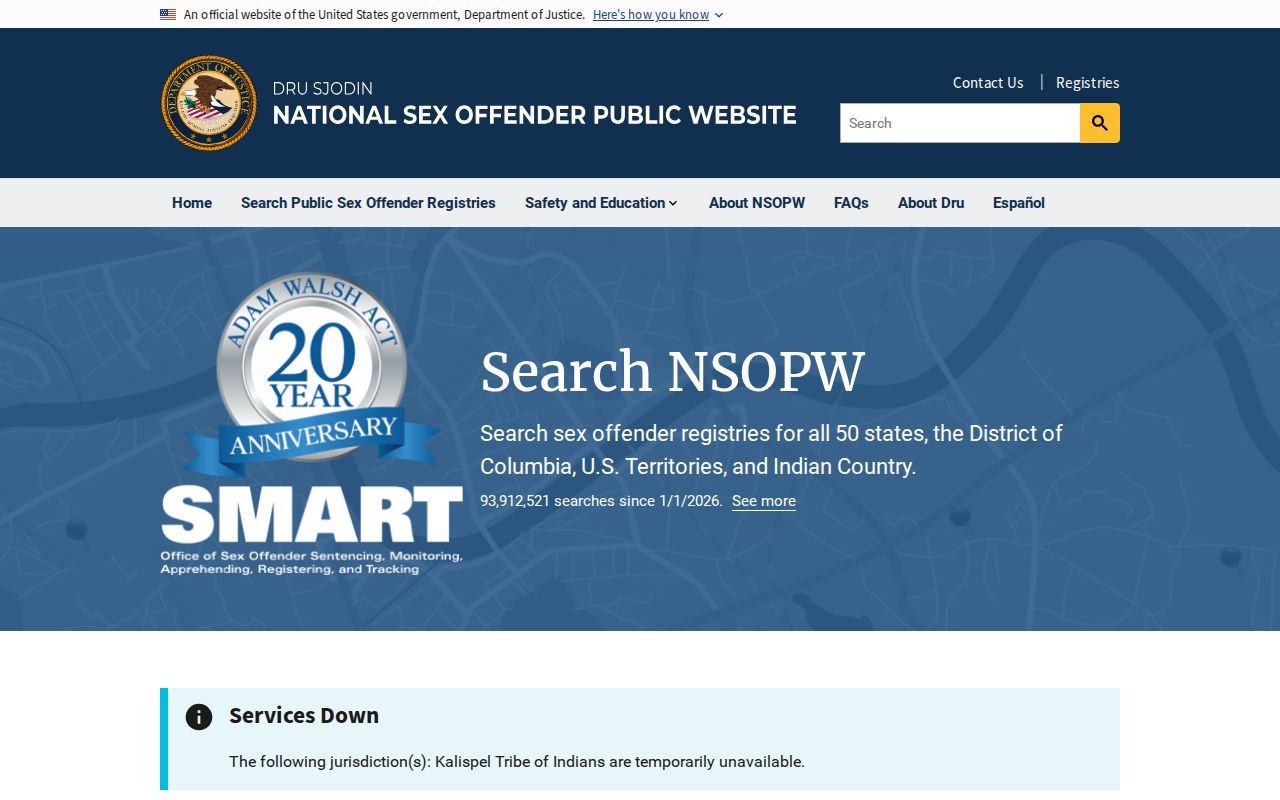
Use NSOPW as the broad layer, then return to the source jurisdiction’s profile for current detail and the listed authority. Different states can display different fields and apply different registration rules.
What a Registry Profile Shows
A public profile provides identifying and registration information authorized by Texas law. It deliberately excludes sensitive information such as Social Security and driver-license numbers, phone numbers, online identifiers, employer details, confidential DPS data, and information that identifies a victim.
| Name and aliases | Published legal and alternate names used to distinguish identity. |
|---|---|
| Photo and description | Current color photograph plus sex, race, age, height, weight, hair, eyes, and marks when displayed. |
| Residence or location | Public address or location and the primary registration authority. |
| Offense information | Offense description, statute, adjudication date, court, state, and authorized victim age/sex category. |
| Risk and status | Texas risk level, registration status, and authority information. |
| Other identifiers | SID, aliases, scars, tattoos, and selected vehicle information where the statute permits. |
Juvenile registration can be nonpublic by court order. A public profile documents a reportable adjudication and current duty, but it is not evidence of any new act.
Texas Registry Program for Burnet County
The official TxDPS registration-program page explains the statewide system behind Burnet County listings and public notification.
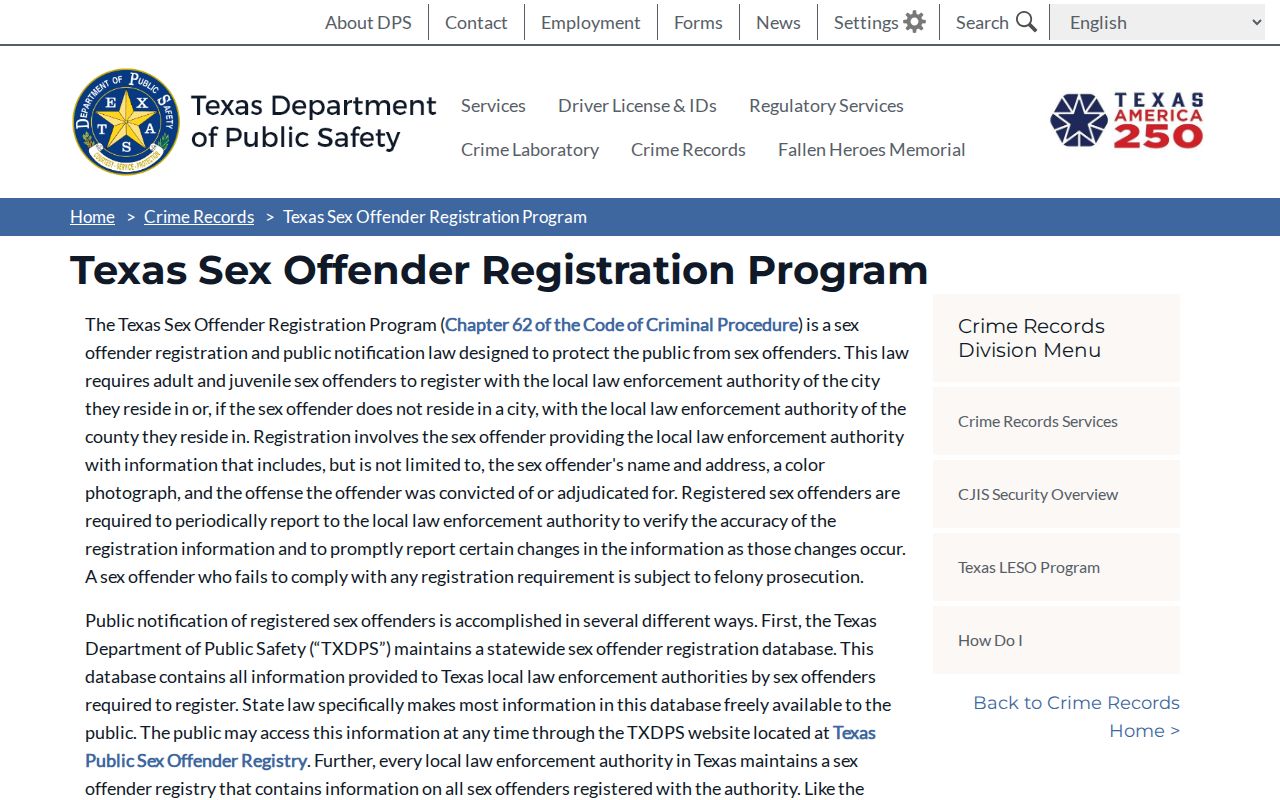
The program page is the stronger source for statewide duties, while a person’s current public profile supplies the registration authority and record-specific status.
Registration Requirements and Levels in Texas
Texas risk levels describe assessed danger; they do not by themselves set the registration clock. Adults generally register for ten years after the later controlling release or discharge event, or for life when Chapter 62 assigns a lifetime duty. Juvenile duties generally run ten years from disposition or completion, whichever is later, subject to the statute.
| Display | Meaning | Duration and verification |
|---|---|---|
| Level 1 / Low | Low danger; not likely to engage in criminal sexual conduct | Duration remains offense-based; ordinary statutory verification |
| Level 2 / Moderate | Moderate danger; may continue such conduct | Offense-based ten-year or lifetime duty |
| Level 3 / High | Serious danger; expected to continue such conduct | Heightened notice; duration remains offense-based |
| Civil Commitment | Court-designated sexually violent predator under specialized supervision | Intensive reporting within a statutory lifetime framework |
Verification can be every 30 days for civilly committed persons, every 90 days for people with two or more sexually violent offenses, and otherwise at the frequency Chapter 62 assigns.
Burnet Risk Level Is Not the Clock
A common reading error is to treat Level 1, 2, or 3 as a federal-style tier that fixes a public duration. Texas does not use that simple relationship. Risk describes assessed danger, while the offense category and controlling discharge or release date determine whether the duty runs ten years or for life.
- Risk level
- The Texas assessment displayed as low, moderate, or high.
- Registration duration
- The offense-based statutory period, often ten years or life for an adult.
- Primary registration authority
- The local police department or Sheriff responsible for the person’s current address.
- Verification
- The required periodic confirmation of registration information.
Read all four fields together. A low-risk label does not automatically mean a short duty, and a high-risk label does not supply the controlling end date by itself.
Burnet County High-Risk Notification
When a high-risk or civilly committed person moves into a community, DPS provides postcards in English and Spanish to the immediate area. Local authorities also make required school notifications and update the statewide registry. These formal paths allow awareness without confrontation.
Chapter 62 does not itself create one statewide general residency-distance rule based only on registration. Probation, parole, or other supervision conditions and valid local law can impose separate restrictions. A map result should not be used to invent a distance rule or declare an address unlawful.
When a Burnet Listing Looks Outdated
First reopen the current DPS profile and confirm the name, authority, status, and date-sensitive details. Do not rely on an old screenshot or a copied listing. If the address is within a city, contact the listed municipal police registration authority. For an unincorporated Burnet County address, contact the Sheriff at 512-756-8080.
Suspected noncompliance should be reported to the listed local authority or law enforcement. Give the profile identifier and factual reason for concern. Do not visit the address, follow the person, publish private household data, or conduct an in-person investigation.
A recent move can involve local verification and transmission before every public field reflects the change. A spelling variation can also hide a result that appears through an address, county, or map search. Try another official search mode, check aliases, and then use the authority shown by DPS. That office can determine whether the record needs correction or whether a compliance report should be opened.
Lawful Use and Community Notification
Registry information supports personal, family, and neighborhood safety. Review the official profile, discuss age-appropriate safety plans, and use formal notification or law-enforcement channels. The record does not authorize a reader to infer new conduct or punish a person outside the law. Save the official profile identifier when reporting an apparent error because a name or copied image alone can point to the wrong person.
Lawful use required: Texas Code of Criminal Procedure Chapter 62 does not authorize threats, harassment, vigilantism, trespass, or any other crime against a registrant or household.
DPS’s current registry and the local registration authority are the correct channels for corrections. A commercial repost can be stale, stripped of context, or detached from the official status and must not replace the government source. For community awareness, prefer the government notice and current map. If immediate danger exists, contact law enforcement rather than using the registry contact process as an emergency channel.