
Criminal Cases in the Burnet County Courts
Burnet County criminal cases are divided by offense level and place. The 33rd and 424th District Courts hear felonies, and the Burnet County District Clerk keeps those criminal files, along with some misdemeanor and grand-jury proceeding records. The District Clerk also issues warrants, commitments, subpoenas, writs, and appellate records. Class A and B misdemeanors, plus appeals from lower courts, go to Burnet County Court at Law. Its misdemeanor calendar generally runs Monday and Thursday, but the court asks parties to contact it about settings and resets.
Traffic, ordinance, and other fine-only Class C cases remain with the justice or municipal court that created them. Burnet County has four justice precincts. Burnet, Marble Falls, and Granite Shoals also have municipal courts for matters within their city jurisdiction. A city citation will not appear merely because a searcher calls the county misdemeanor counter.
Burnet Felony Files at Annex North
The phrase “county courthouse” can send a records visitor to the wrong Burnet County building. Felony case files are at Courthouse Annex North, not the historic courthouse square. The District Clerk Criminal Division is at 1701 East Polk Street, Suite 90, Burnet, Texas 78611. It is open Monday through Friday from 8:00 a.m. to 4:00 p.m.; the phone is 512-756-5450.
Burnet County District Clerk
Courthouse Annex North
1701 E. Polk St., Suite 90
Burnet, TX 78611
512-756-5450
Felony, some misdemeanor, grand-jury, warrant, commitment, and appellate records.
County Misdemeanor Records
220 S. Pierce St.
Burnet, TX 78611
512-756-5406
County Clerk misdemeanor files; County Court at Law is in Room 206.
Give the clerk a case number when possible. For a name search, add a filing year or approximate date to reduce same-name mistakes and ask whether an archived file requires staff retrieval.
How to Search Case Records
Burnet County offers local court-record entry points, and re:SearchTX provides a statewide layer. Neither should replace a clerk check when the latest order, a certified copy, or a document image is needed. Search results should be treated as an index into the court file.
- Decide whether the matter is felony, Class A or B misdemeanor, or fine-only/Class C, and select the matching Burnet County court.
- Use the case number if known. Otherwise enter the defendant’s legal name and narrow by court, case type, or filing year.
- Match the court, filing date, and offense text before opening a result. A shared name alone is not enough.
- Open the event or docket view and find the most recent signed order, judgment, dismissal, or disposition.
- Ask the correct clerk for a plain or certified copy when the image is absent, restricted, archived, or fee-gated.
| Search field | Use | Required | Burnet County note |
|---|---|---|---|
| Case number | Text | No, but preferred | Best way to avoid a same-name match |
| Defendant name | Text | Search-dependent | Use full legal spelling and alternatives |
| Court | Selection | No | Separate district, county, justice, and municipal files |
| Filing year | Date/year | No | Narrows common names and older matters |
| Case type | Selection | No | Use criminal and the correct offense level |
Burnet County Court Levels Compared
The filed charge, not the arrest label alone, determines the lasting court trail. This local division helps direct a request before a search begins.
| Court | Criminal role | Primary records contact |
|---|---|---|
| 33rd and 424th District Courts | Felony trial cases | District Clerk, 512-756-5450 |
| County Court at Law | Class A/B misdemeanors and lower-court appeals | Court 512-715-5245; clerk 512-756-5406 |
| JP Precincts 1-4 | Traffic and other Class C matters by precinct | Each precinct clerk |
| Municipal courts | City ordinance and Class C cases | Burnet, Marble Falls, or Granite Shoals court |
Precincts 3 and 4 are at the South County Annex in Marble Falls. Their location does not turn them into the Marble Falls Municipal Court. Jurisdiction, not the nearest counter, controls.
What the Case File Shows
A Burnet County case file preserves the prosecution as filed and the court’s response. It is richer than a jail entry because it follows pleadings, settings, rulings, and disposition. Yet the clerk’s docket does not contain every investigative fact held by the arresting agency.
| Case number and court | Identifies the file, assigned court, and jurisdiction. |
|---|---|
| Charging document | Shows the complaint, information, or indictment and the offense actually filed. |
| Docket entries | Chronological filings, settings, motions, orders, and court events. |
| Hearing information | Dates and settings, subject to later resets or orders. |
| Disposition and judgment | States dismissal, acquittal, deferred adjudication, conviction, or another result. |
| Sentence and costs | May show custody, community supervision, fines, restitution, and financial balance. |
Document images can be absent or restricted. Birth dates, Social Security numbers, victim identities, juvenile material, sealed filings, and sensitive addresses should not be expected in the public display.
Reading a Burnet Criminal Docket
A status marked “disposed” says the case is closed; it does not say why. Read the specific disposition and the latest signed order. A dismissal is not an acquittal, deferred adjudication is not the same as a final conviction, and an old hearing entry is not proof that a trial occurred.
- Arraignment
- The proceeding where the accused receives the charge and enters a plea.
- Indictment
- A grand jury’s formal felony accusation.
- Disposition
- The way a charge ends, such as dismissal, acquittal, deferred adjudication, or conviction.
- Docket
- The chronological list of settings, filings, and court events.
- Capias
- A writ directing arrest, often tied to a court event or judgment.
When DPS history lacks a disposition, the local clerk’s certified order can help document the correct Burnet County outcome for a repository correction process.
Stages of a Criminal Case
Burnet County criminal procedure moves from an accusation toward a filed case, but the prosecutor can change, reduce, enhance, or decline the arrest charge. A felony may pass through grand-jury review before the District Clerk opens the lasting prosecution file. Misdemeanors commonly proceed by complaint or information.
Case flow: Charges Filed › Arraignment › Pretrial › Plea or Trial › Disposition › Sentencing
After judgment, an appeal or community-supervision issue can add later filings. The case docket is therefore a timeline, not a one-time snapshot. For the custody event that came before filing, use the separate Burnet County arrest history channels.
When Burnet Case Images Are Missing
A result without a downloadable pleading is not necessarily an empty file. Online systems can omit document images, older files may sit in archives, and access may vary by court. Record the case number, court, document title, and event date, then contact the custodian for a copy and cost estimate.
For felony material, contact the District Clerk. For Class A/B misdemeanor documents, contact the County Clerk misdemeanor counter or County Court at Law. Fine-only documents belong to the issuing JP or municipal court. Ask whether a plain copy answers the need or whether a certified copy is required. No universal Burnet County criminal-copy fee was confirmed, so the clerk’s current estimate controls.
A narrow request is easier for staff to answer than a demand for everything connected to a person. Identify the indictment, information, judgment, sentencing order, dismissal, bond order, or docket sheet that answers the question. If the event list shows a filing without its image, quote the event date and description. For an older Burnet County file, ask whether archive retrieval adds time and whether the clerk can send an electronic copy. A certified copy serves a different purpose from a screen print because the clerk authenticates the court document.
Access & Restrictions
Texas court records operate under judicial access rules as well as statutes. They are not always handled like an executive-agency request under the Texas Public Information Act. The Texas Judicial Branch rules and standards explain that distinction, while the clerk determines access to a specific Burnet County file.
Juvenile records, sealed or expunged matters, grand-jury deliberations, victim-identifying data, medical information, and protected personal identifiers can be confidential or redacted. An online omission may also reflect indexing, archive, or portal limits rather than a sealing order. Ask the clerk to confirm the case and its access status instead of inferring an outcome from silence.
Access rule: Texas Government Code Chapter 552 governs agency records, while court-file access also follows judicial rules. Chapter 55A controls qualifying expunctions, and Chapter 411 governs nondisclosure.
Burnet Court Search Statewide
The official re:SearchTX landing page shows the statewide court-search layer available alongside Burnet County clerk channels.
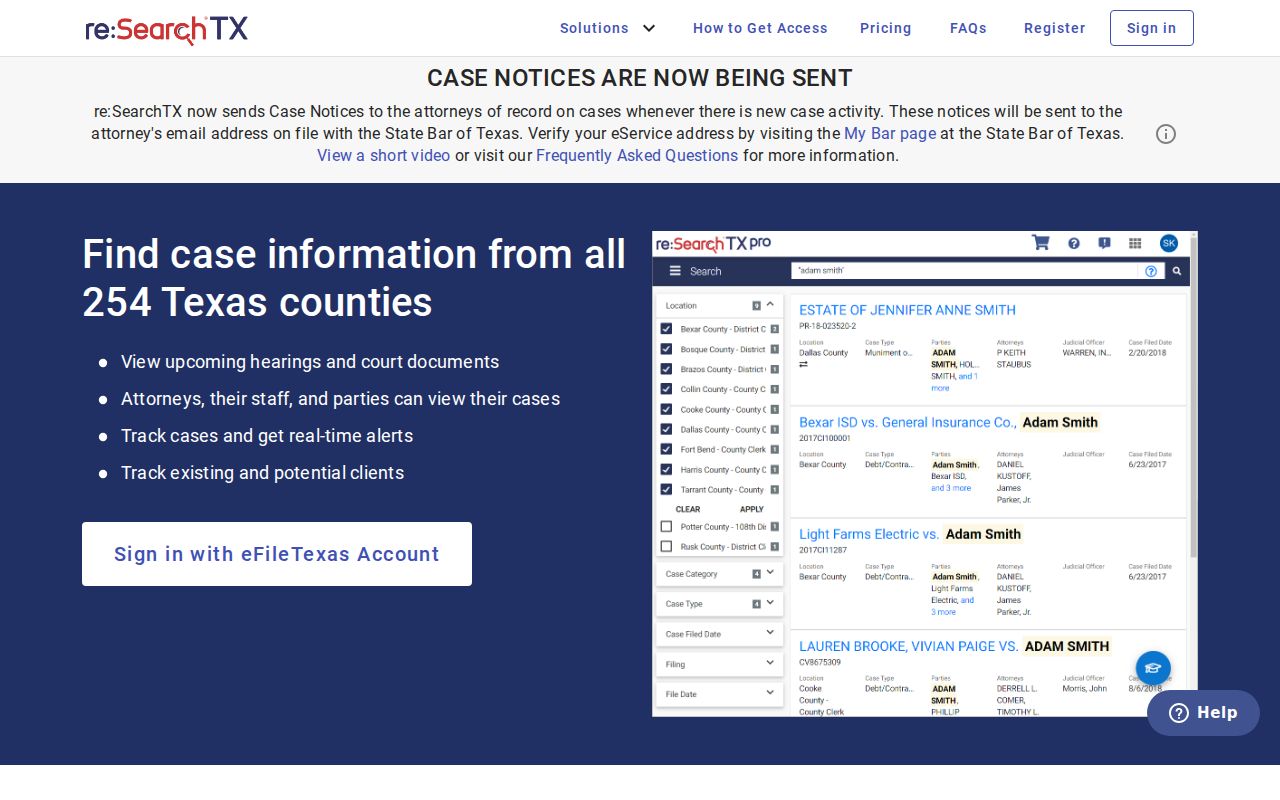
The statewide view helps locate a court and case, but the Burnet County clerk remains the source for current local documents and certified dispositions.